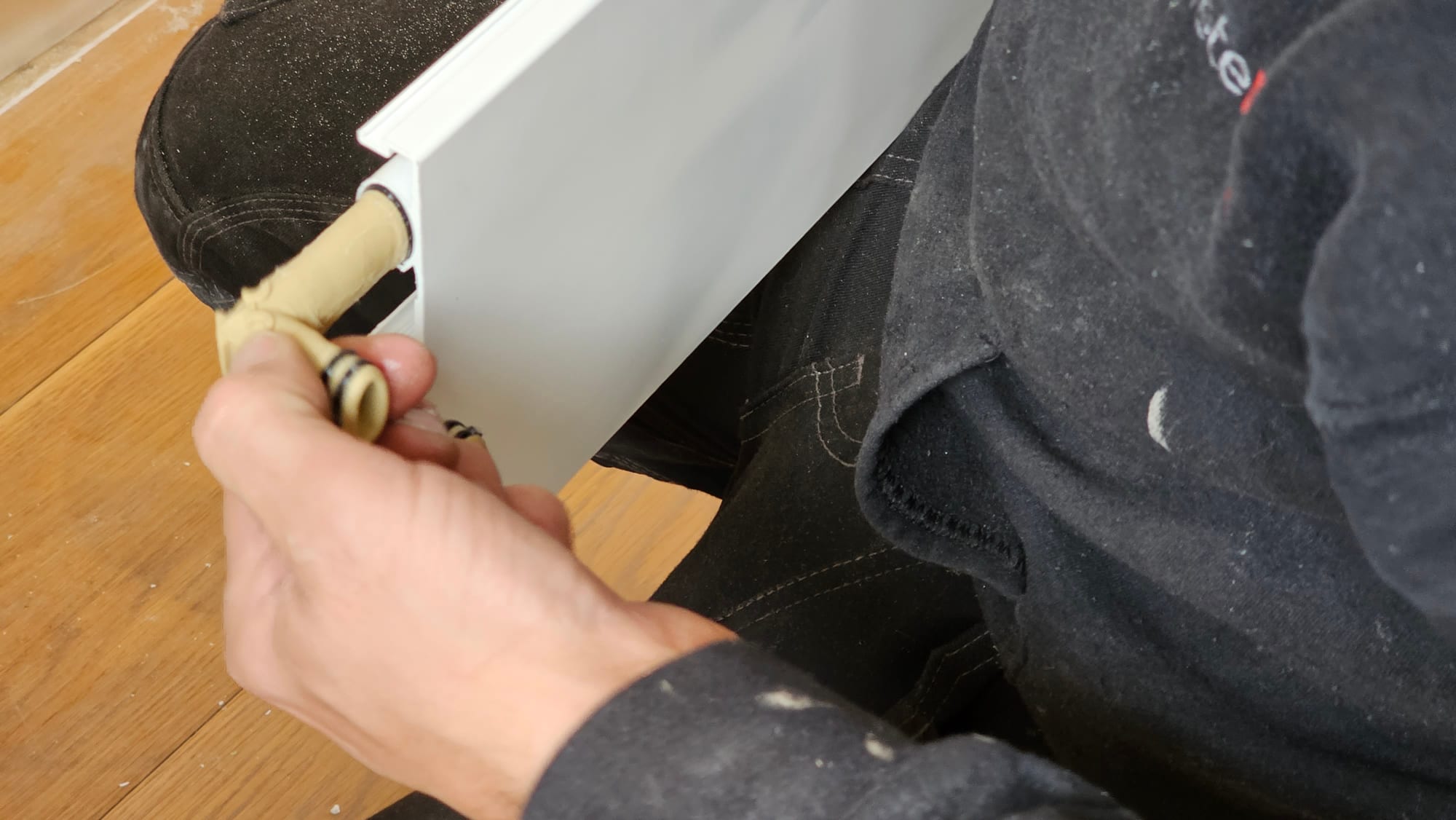
Water treatment protocol.
ThermaSkirt is an aluminium emitter, so the system water must be correctly treated and pH-stabilised. This is the unambiguous protocol that protects the system and the warranty, with the aluminium-specific requirements stated up front.
Warranty condition: ThermaSkirt's 10-year wet-parts warranty is conditional on correct water treatment. Aluminium is susceptible to corrosion with incorrect pH or untreated water. Failure to provide suitably treated and pH-stabilised water invalidates the warranty. The aluminium-specific requirements below are not optional.
An aluminium emitter needs aluminium-safe water.
Aluminium is an excellent heat conductor, which is why ThermaSkirt uses it, but it is more sensitive to water chemistry than steel. Water that is too acidic, too alkaline, untreated, or artificially softened can corrode the emitter over time.
The protocol on this page is straightforward and follows recognised standards. The two requirements that are specific to aluminium, a controlled pH band and no base-exchange softened water, are the ones to get right first.
- ThermaSkirt is an aluminium emitter, and aluminium corrodes if the system water has the wrong pH or is left untreated. Correct water treatment is a condition of the warranty.
- Maintain system water pH between 6.8 and 8.3 at all times.
- Never use base-exchange softened water in a system containing ThermaSkirt.
- Clean and flush the system, then dose an appropriate corrosion inhibitor at the correct concentration for the system volume.
- Never leave the system filled with untested or untreated water for extended periods; pressure-test with air, or temporarily with water and then drain.
- ThermaSkirt contains no ferrous metal, so it generates no magnetite; but where it shares a circuit with existing steel radiators, a full system inhibitor and a magnetic filter are still required.
- Follow BS 7593, EN 14336 and VDI 2035. Failure to provide suitably treated and pH-stabilised water invalidates the warranty.
Keep system water pH between 6.8 and 8.3
The single most important figure for an aluminium emitter. Outside this band, the protective oxide layer on the aluminium is at risk. Test at commissioning and whenever the system is drained or topped up.
Six steps, in order
From a clean system to fit-and-forget operation. Each step protects the aluminium and keeps the warranty valid.
The ThermaSkirt Cleanser & Inhibitor Kit
Rather than leave the inhibitor choice open, DiscreteHeat supplies a matched kit specified for the aluminium emitter. It covers the cleaning and inhibiting steps of the protocol above, and is quoted as standard with every ThermaSkirt system.
It is designed for mixed-metal systems, where aluminium ThermaSkirt connects to copper or steel pipework, and using it is required to maintain the 10-year wet-parts warranty.
Buy the kit- SM-Pro System CleanserRemoves flux, solvents, acids and debris left by a new installation.
- CM10 Corrosion Inhibitor (×2)Sacrificial-anode formula that keeps protecting the aluminium through drain-downs and refills.
- Inline 22 mm compression fittings (×3)To dose and isolate the system cleanly.
Do and don't
Do
- Maintain pH 6.8–8.3
- Clean and flush before commissioning
- Dose an aluminium-suitable inhibitor at the correct concentration
- Fit a magnetic filter on mixed-metal (steel radiator) systems
- Pressure-test with air, or with water then drain
Don't
- Use base-exchange softened water
- Leave the system filled with untreated water
- Rely on mains water alone, with no inhibitor
- Mix incompatible inhibitor and glycol products
- Assume an existing dirty system is clean enough
Mixed-metal systems
ThermaSkirt itself contains no ferrous metal, so it does not produce magnetite or rust. On a ThermaSkirt-only system there is no iron-oxide sludge originating from the emitter.
However, where ThermaSkirt shares a circuit with existing steel-panel radiators, those radiators still generate magnetite. A full-system corrosion inhibitor and a magnetic filter remain necessary on any mixed-metal installation. The supplied Cleanser & Inhibitor Kit is formulated for exactly these aluminium, copper and steel systems.
Pressure test and commissioning
Pressure-test with air, or temporarily with water and then drain. Never leave the system standing full of untreated water, even briefly between trades.
Because ThermaSkirt runs horizontally, like underfloor heating, it does not collect air in normal operation, so there is no routine bleeding once commissioned. A commissioning purge is still required to clear air at first fill.
Which standards apply
| BS 7593 | Code of practice for the preparation, commissioning and maintenance of domestic central heating water systems, including cleaning, flushing, inhibitor dosing and water testing. |
| EN 14336 | Installation and commissioning of water-based heating systems in buildings, including filling, flushing and commissioning procedures. |
| VDI 2035 | Guideline on the prevention of damage in water heating installations, covering both scale formation and water-side corrosion. |
On heat-pump systems with glycol antifreeze, confirm that the inhibitor and glycol are compatible and aluminium-suitable, and dose to the manufacturer's instructions. Our technical team can advise on suitable products.
The pH band (6.8–8.3), the prohibition on base-exchange softened water and the warranty condition are DiscreteHeat's published requirements for the ThermaSkirt aluminium emitter, as stated on the product datasheets. The cleaning, flushing, inhibitor and commissioning procedures follow BS 7593, EN 14336 and VDI 2035. This page is general guidance; for a specific system, follow the inhibitor manufacturer's instructions and the current published standards. Last reviewed June 2026, maintained by DiscreteHeat Ltd.
Everything you need to know
What pH should the system water be?
Can I use softened water?
Does correct water treatment affect the warranty?
Does ThermaSkirt produce sludge or need a magnetic filter?
Does ThermaSkirt need bleeding like a radiator?
Which cleanser and inhibitor should I use?
How should the system be pressure-tested?
What about glycol on heat-pump systems?
Explore related Technical Data
The product specifications, the underlying physics, and the material the emitter is made from.


Commissioning a ThermaSkirt system?
Our technical team can confirm the water-treatment and inhibitor requirements for your system, including mixed-metal and heat-pump installations.