HEM & SAP 10.2.
ThermaSkirt is a low-temperature radiant wet emitter that sits between a radiator and underfloor heating on every variable the energy model uses. This page sets out how an assessor should treat it, and the case DiscreteHeat has submitted to BRE for explicit recognition in the Home Energy Model.
Status: ThermaSkirt is not yet a distinct emitter class in HEM. In May 2026 DiscreteHeat submitted a formal application to the BRE/DESNZ HEM Working Group requesting that it be added to the Product Characteristics Database. Until that is accepted, HEM defaults ThermaSkirt to the radiator class, which understates its low-flow-temperature performance. The figures on this page are from that application and its EN 442-1 verified test data.
SAP today, HEM for the Future Homes Standard.
SAP 10.2 is the current methodology for assessing dwelling energy performance. The Home Energy Model (HEM) is its successor, the methodology that underpins the Future Homes Standard. Where SAP runs a monthly calculation, HEM simulates the dwelling at 30-minute resolution, modelling the heat pump against the emitter circuit's instantaneous demand.
That makes the emitter, and specifically how it behaves at low flow temperatures, a first-order input rather than a background assumption. The substantive, transferable point for ThermaSkirt is its classification as a low-temperature radiant emitter designed at ΔT20, not any single headline number.
- The Home Energy Model (HEM) is the methodology that replaces SAP for assessing dwelling energy performance under the Future Homes Standard. SAP 10.2 is the current methodology in use today.
- HEM models a wet emitter on three variables: its characteristic exponent (output retention at low flow temperature), its convective/radiant split, and its thermal mass. ThermaSkirt sits between radiators and underfloor heating on all three.
- ThermaSkirt has EN 442-1 verified exponents of n = 1.2245 (BM2) and n = 1.1714 (BM3), between the radiator default (n = 1.30) and underfloor heating (n = 1.00).
- At the ΔT20 heat-pump design point, ThermaSkirt retains 33–34% of rated output, against 30% for a radiator and 40% for underfloor heating.
- ThermaSkirt has the radiant character and low-flow performance of underfloor heating, but a thermal mass close to a radiator (~55 kJ/K vs ~800–1,400 kJ/K for UFH), so it carries no screed charge-up penalty.
- DiscreteHeat has formally applied to BRE/DESNZ (May 2026) for ThermaSkirt to be added to the HEM Product Characteristics Database as a distinct emitter class. Until then, HEM defaults it to the radiator class, which understates its low-flow performance.
How is ThermaSkirt classified for energy modelling?
HEM uses three emitter properties to calculate space-heating energy. On each one, ThermaSkirt sits between the radiator and underfloor-heating defaults. The combination is what neither default can represent: the low-flow performance and radiant character of underfloor heating, with the low thermal mass and fast response of a radiator.
| HEM variable | Radiator | ThermaSkirt | Underfloor |
|---|---|---|---|
Characteristic exponent (n) Output retained as the heat-pump flow temperature falls. Lower is better. | 1.30 | 1.17 to 1.22 | 1.00 |
Convective fraction Share of heat delivered to the air vs radiated to surfaces and people. Lower is more radiant. | 0.65 to 0.80 | 0.40 to 0.50 | 0.45 to 0.50 |
Thermal mass Kᴇ Energy spent warming the emitter itself at every timestep. Lower responds faster. | ~60 to 80 kJ/K | ~55 kJ/K | ~800 to 1,400 kJ/K |
ThermaSkirt exponents EN 442-1 verified (n = 1.2245 BM2, n = 1.1714 BM3). Convective fraction estimated pending formal characterisation; values from CIBSE Guide A, BS EN 15316-2 and EnergyPlus references. Thermal mass Kᴇ illustrative for a 700 W heat-loss room. Source: DiscreteHeat HEM application, May 2026.
Between a radiator and underfloor heating, on every axis.
Why the exponent matters at heat-pump flow temperatures
Every wet emitter is rated at ΔT50 (around 75°C flow). As a heat pump lowers the flow temperature, output falls by the power law output = rated × (ΔT / 50)n. A lower exponent gives a flatter curve, so more output is retained. The gap is modest at high ΔT and widens through the heat-pump operating range.
| ΔT (to 20°C room) | Radiator | BM2 | BM3 | UFH |
|---|---|---|---|---|
| ΔT50 | 100% | 100% | 100% | 100% |
| ΔT40 | 75% | 76% | 77% | 80% |
| ΔT30 | 51% | 53% | 55% | 60% |
| ΔT20 (HP design) | 30% | 33% | 34% | 40% |
| ΔT10 | 12% | 14% | 15% | 20% |
Percentage of rated output retained, calculated from the BS EN 442 power law using EN 442-1 verified exponents. The advantage over a radiator widens as ΔT falls: at ΔT20 the BM3 advantage is around +12%, reaching +23% at ΔT10, the part-load conditions where a heat pump spends most of the heating season. See Product Data for the W/m output tables.
Thermal mass: no screed to charge
HEM charges energy for warming the emitter itself at every 30-minute timestep. Underfloor heating must heat a heavy screed first (~800–1,400 kJ/K for a representative room), which delays useful heat at start-up and draws heat back out of the room as it cools.
ThermaSkirt's thermal mass is about 55 kJ/K, roughly 19 times lower than underfloor heating and modestly below a comparable steel-panel radiator. It warms up and cools down almost as fast as a radiator, so it tracks a weather-compensated heat pump with little wasted energy.
Convective fraction: mostly radiant
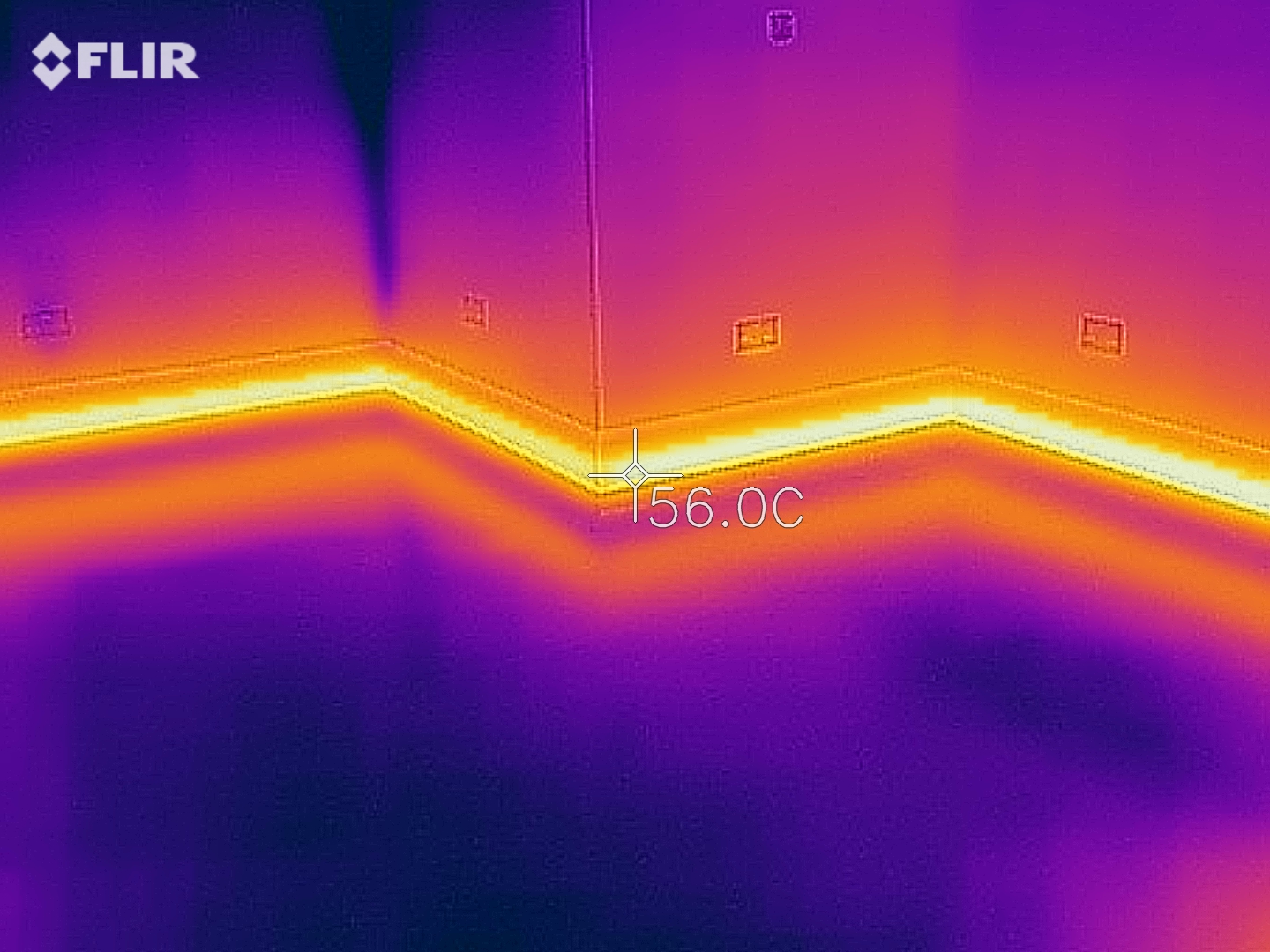
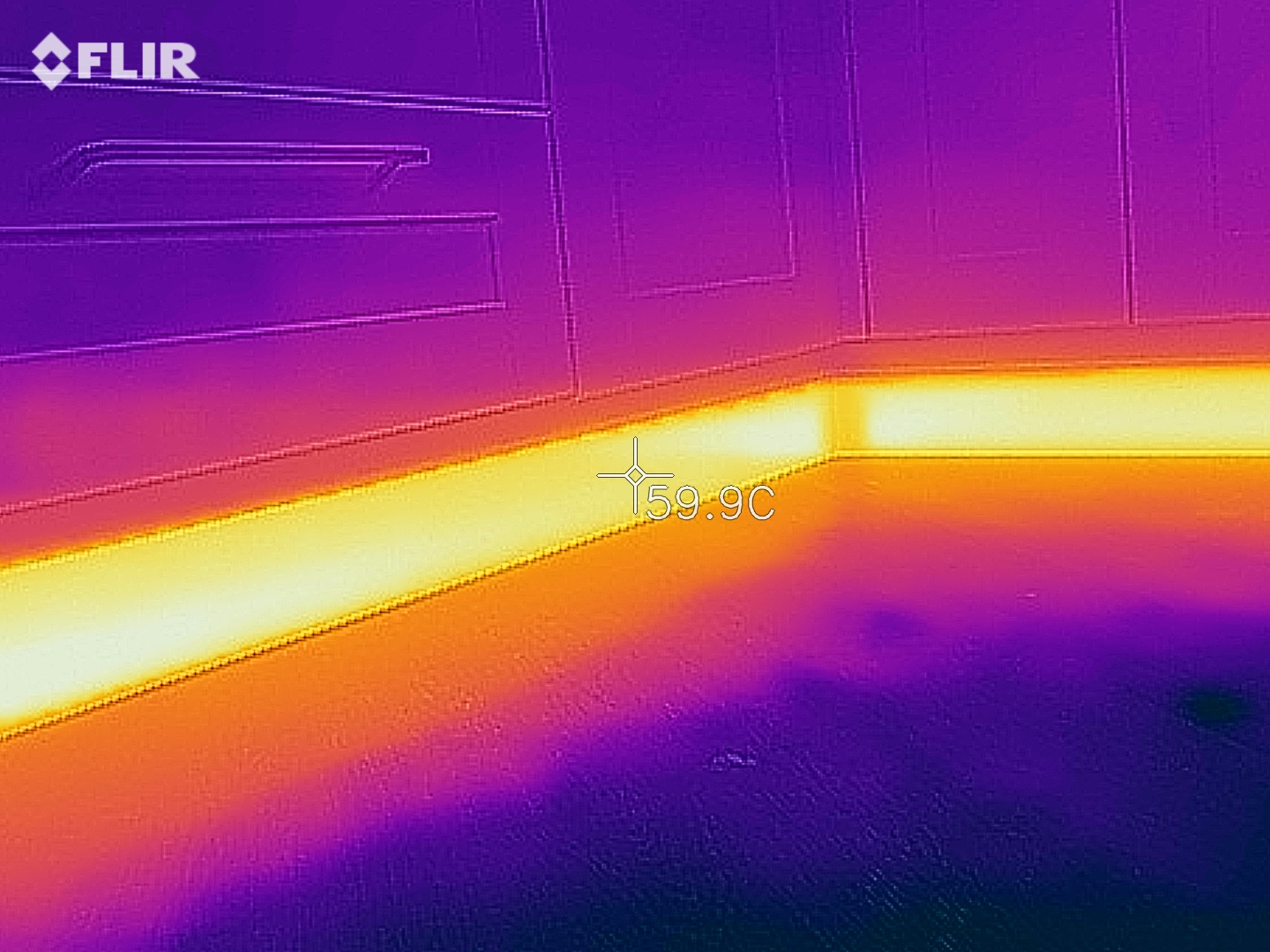
With a sealed aluminium face and no fins or grilles, ThermaSkirt delivers an estimated 40–50% of its heat by convection and the rest by radiation, close to underfloor heating and well below a finned radiator (65–80%).
A higher radiant fraction lifts mean radiant temperature, which lets the air setpoint sit lower for the same comfort. This is backed by independent BSRIA CFD analysis showing a 2°C higher mean operative temperature at the same heat input. See the Thermal Comfort analysis.
What efficiency improvement results?
Heat-pump efficiency rises as flow temperature falls. The widely cited MCS rule of thumb (Domestic Heat Pumps: Best Practice Guide) is that every 1°C reduction in flow temperature improves heat-pump electricity consumption by roughly 2.5%. Because ThermaSkirt retains more output at low ΔT, it can be designed for a lower annual average flow temperature for the same heat delivery.
In a worked comparison from the HEM application, a BM3 system delivering the same output as a radiator design runs at a modestly lower mean water temperature, which by the 2.5%-per-°C rule of thumb corresponds to roughly a 2–4% reduction in seasonal space-heating electricity (around 4% for BM3, 2.3% for BM2 at the design point). This is illustrative and depends entirely on the dwelling, fabric and controls. It is not a universal figure, and the transferable benefit is the low-temperature radiant classification, not any single percentage.
How should an assessor model ThermaSkirt in SAP 10.2?
Under SAP 10.2, ThermaSkirt is modelled as a low-temperature radiant wet emitter. The principle is the same as in HEM: a low design flow temperature, a fast emitter response, and modern weather-compensating controls. The reference points an assessor needs are below.
| Emitter type | Low-temperature radiant wet emitter |
| Design condition | ΔT20 (≈45°C flow / 35°C return, 20°C room) |
| Responsiveness | Fast (low water volume, low thermal mass) |
| Heating controls | Weather and load compensation (Class VI) |
| Heat pump design flow (Appendix N) | 40°C, or 35°C where the fabric allows |
These are the qualitative SAP 10.2 modelling inputs. The exact numeric efficiency adjustments and any SAP-rating uplift are dwelling-specific and should be confirmed by a qualified SAP assessor against your scheme. Our technical team can support an assessment with the underlying test data.
What DiscreteHeat has asked BRE to do
In May 2026 DiscreteHeat submitted a technical application to the BRE/DESNZ HEM Working Group. It requests that ThermaSkirt be modelled on its measured characteristics rather than the radiator default.
Everything you need to know
Is ThermaSkirt recognised in the Home Energy Model?
What exponent should be used for ThermaSkirt?
How much output does ThermaSkirt retain at heat-pump flow temperatures?
Why not just model ThermaSkirt as underfloor heating, since both are radiant?
What is the difference between SAP 10.2 and HEM?
Does ThermaSkirt guarantee extra SAP points?
What evidence supports these figures?
Explore related Technical Data
The physics, the comfort evidence, and the output data behind the energy-model case.


Modelling ThermaSkirt on an FHS scheme?
Our technical team can supply EN 442-1 test reports, exponent and thermal-mass data, and SAP/HEM modelling guidance to support your assessment.