Radiant heat science.
Why heating the perimeter of a room with a low-temperature radiant strip behaves so differently from a convector radiator, and why that difference matters more, not less, as flow temperatures fall on a heat pump.
Warm the surfaces, not just the air.
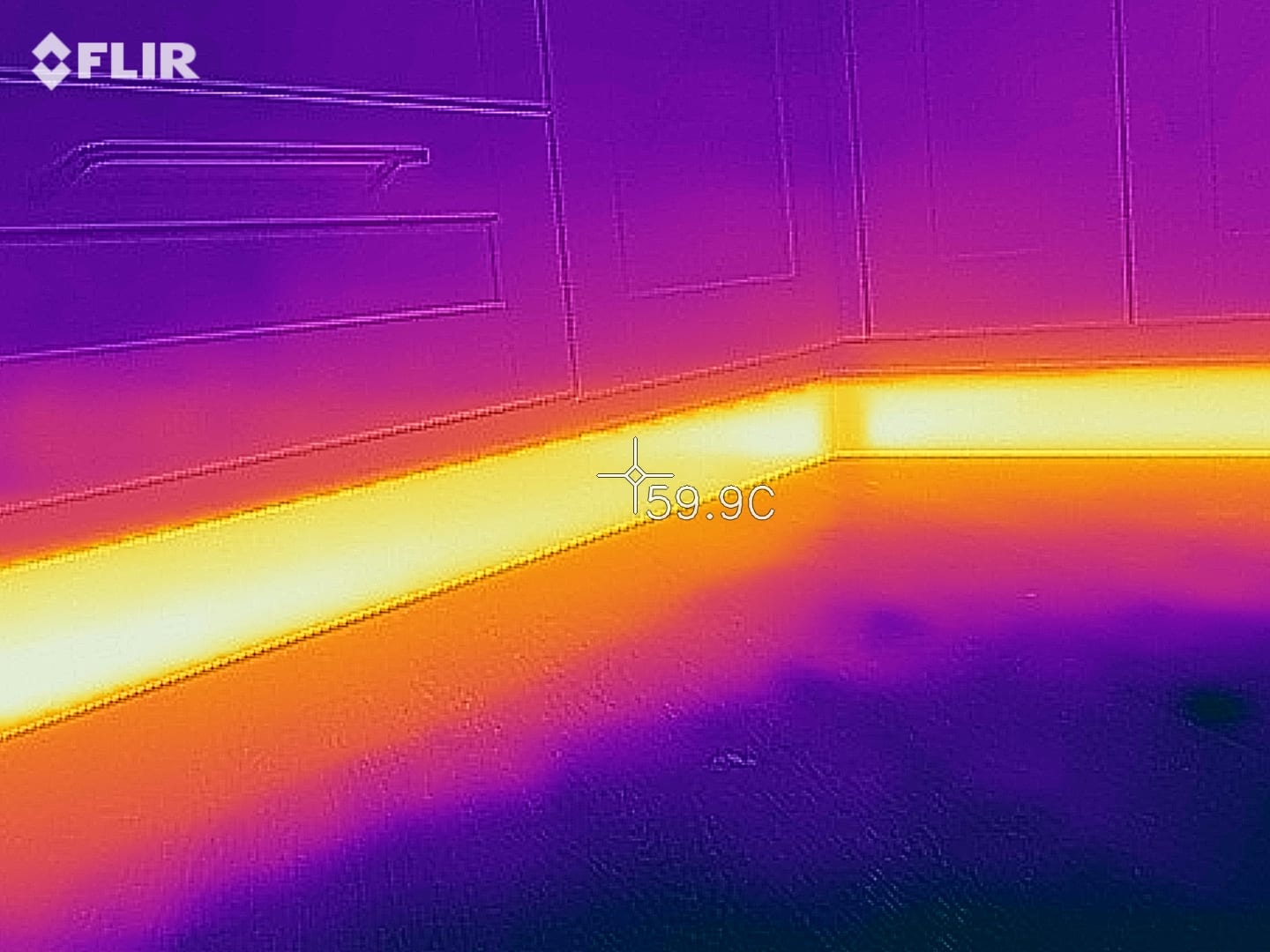
A convector radiator heats the air passing through its fins; that warm air rises, crosses the ceiling and cools as it falls on the far side of the room. A radiant emitter instead sends infrared energy directly to the surfaces and people in its line of sight, warming the fabric of the room rather than driving an air current.
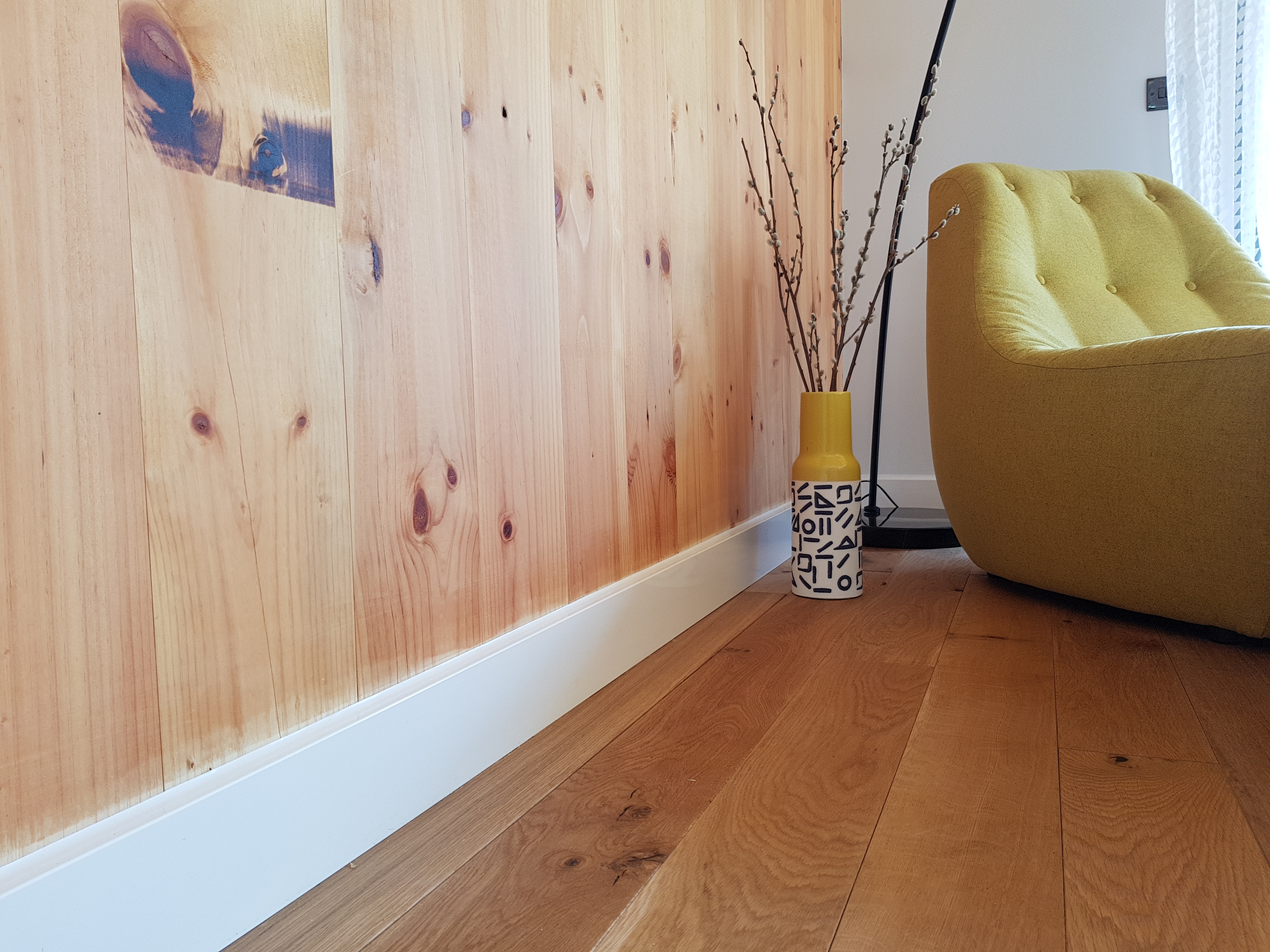
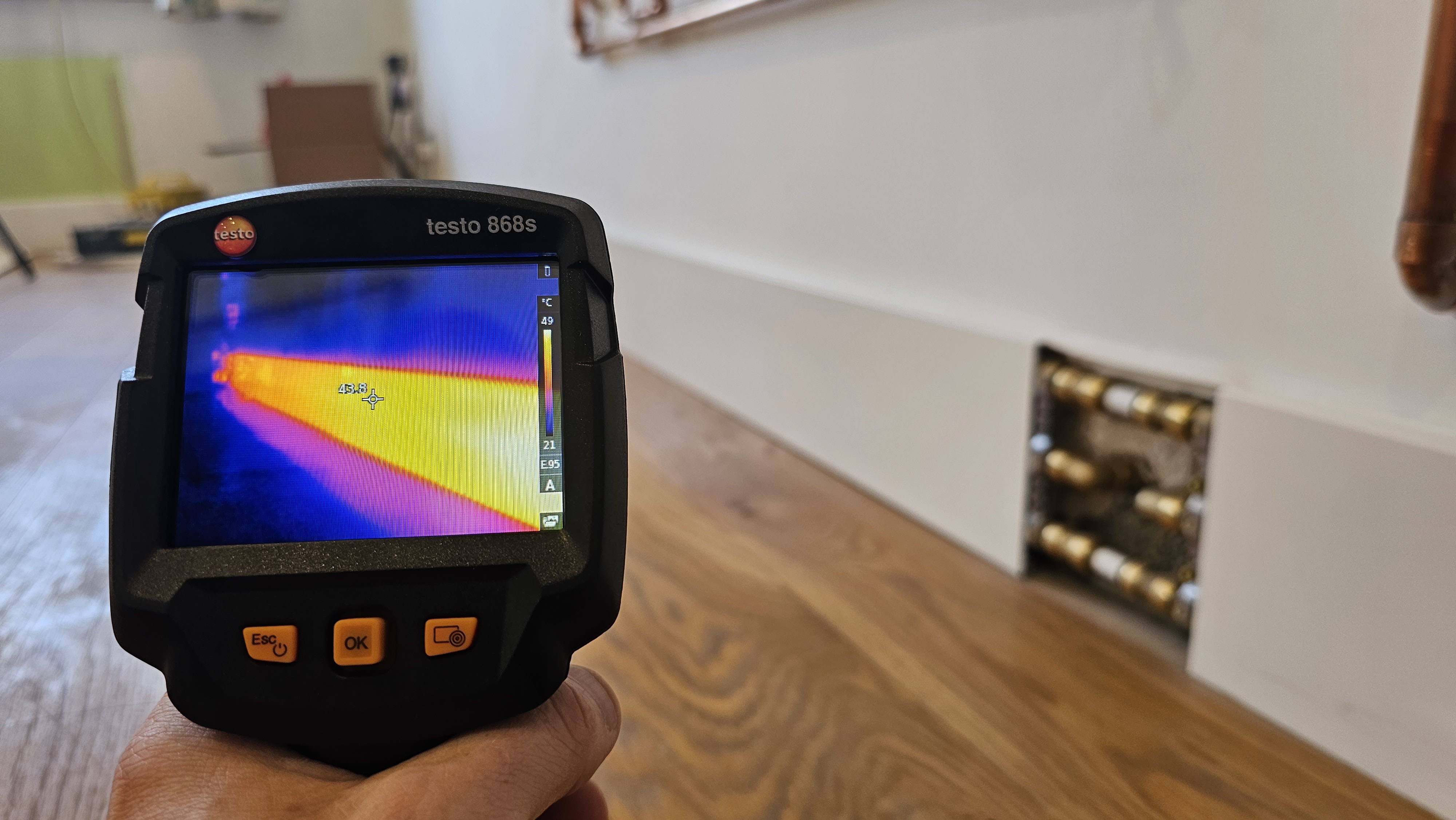
ThermaSkirt is a low-temperature radiant strip running around the room perimeter. This page sets out the physics behind that behaviour, and why it is the conceptual anchor for the comfort, output and energy-model evidence elsewhere in this hub.
- Radiant heat transfers energy directly to surfaces, furniture and people by infrared; convective heat warms the air, which then circulates and stratifies towards the ceiling.
- ThermaSkirt delivers an estimated 50–60% of its heat by radiation, against 20–35% for a finned panel radiator, because its sealed aluminium face has no fins or grilles to drive convection.
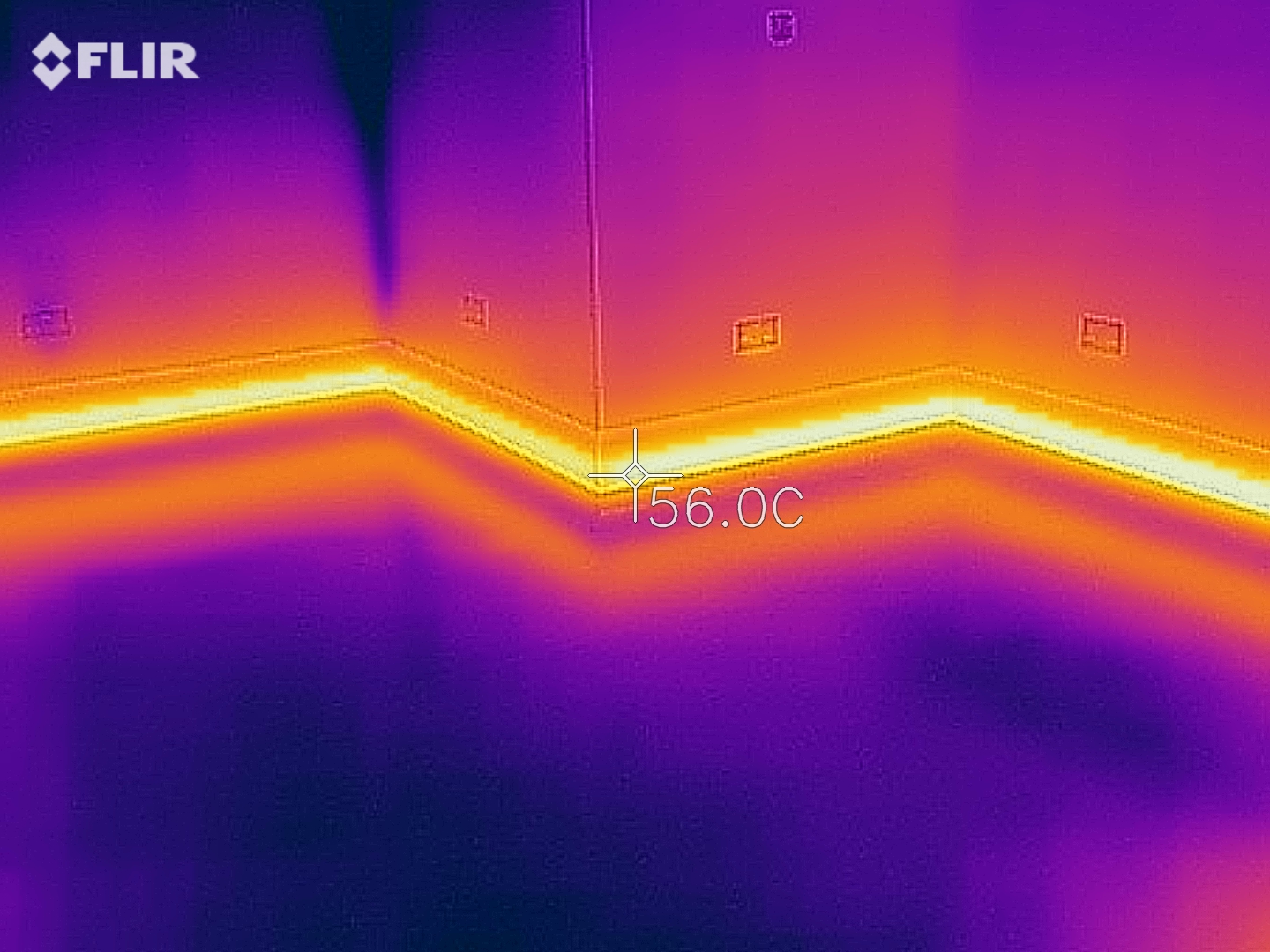
- Emitting around the room perimeter raises the mean radiant temperature of the external walls and corners, the surfaces that are normally coldest.
- Operative (felt) temperature is roughly the average of air temperature and mean radiant temperature; raising the radiant half lets the same comfort be reached at a lower air temperature.
- Because radiation is less sensitive to flow temperature than finned convection, a radiant emitter has a flatter output curve: ThermaSkirt retains 33–34% of rated output at ΔT20 versus 30% for a radiator, and the gap widens as flow temperature falls.
- These are the same physics that give underfloor heating its low-temperature and comfort advantages, but ThermaSkirt achieves them with the fast response and low thermal mass of a radiator.
Two ways to move heat into a room
Every emitter delivers heat by some mix of convection and radiation. The balance between the two decides where the heat ends up, how the room stratifies, and how comfortable it feels at a given thermostat setting.
Convection (a radiator)
Most of the heat goes into the air, which rises and stratifies. Comfort depends on a hot surface and a working air current, so the far corners of the room lag behind.
Radiation (ThermaSkirt)
Heat radiates from the perimeter directly to surfaces and people. The room warms evenly, the gradient stays shallow, and comfort is largely independent of furniture position.
Heat distribution, illustrative.
Heating the coldest surfaces first
A room loses most of its heat through its external walls, windows and the corners between them. Those are also the surfaces that pull radiant heat away from occupants, lowering the felt temperature near a cold wall.
Because ThermaSkirt emits along the perimeter, it warms those external surfaces directly, raising the mean radiant temperature exactly where it is normally lowest. The result is a room that approaches a uniform radiant equilibrium rather than a single warm spot surrounded by cooler air.
Why radiant output holds up as flow temperature falls
A finned radiator depends on convection, and convective output falls steeply as the surface cools. A radiant emitter depends less on a fast air current, so its output curve is flatter, captured by a lower characteristic exponent (n = 1.17 to 1.22 for ThermaSkirt, against 1.30 for a radiator). The lower the exponent, the more output is retained at low ΔT.
The edge over a radiator is modest at ΔT20 but compounds as the flow temperature drops further, which is where a weather-compensated heat pump spends most of the heating season. The full output tables are on the Product Data page, and the energy-model consequences on the HEM & SAP page.
What people actually feel
Thermal comfort is governed by operative temperature, not air temperature alone. Operative temperature is approximately the average of the air temperature and the mean radiant temperature of the surrounding surfaces.
A radiant emitter raises the mean radiant temperature, so the same operative comfort is reached at a lower air temperature. The thermostat can therefore be set lower for equal comfort. BSRIA's CFD analysis measured this as a 2°C higher mean operative temperature for ThermaSkirt versus a radiator at the same heat input.
Lift the radiant half, and comfort holds at a lower air setpoint, which reduces heating demand.
Radiant perimeter, convector radiator, underfloor heating
ThermaSkirt shares the radiant character and low-temperature performance of underfloor heating, but the fast response of a radiator. It sits between the two on the variables that matter.
| Property | Radiant perimeter (ThermaSkirt) | Convector radiator | Underfloor heating |
|---|---|---|---|
| Primary heat transfer | Long-wave radiation to surfaces and people | Convection: air heated through fins | Radiation from the floor surface |
| Output retained at ΔT20 | 34% (BM3), 33% (BM2) | 30% | 40% |
| Characteristic exponent n | 1.17 to 1.22 | 1.30 | 1.00 |
| Convective fraction | 0.40 to 0.50 | 0.65 to 0.80 | 0.45 to 0.50 |
| Response time | Minutes (low water volume, low mass) | Minutes | Hours (screed thermal mass) |
| Distribution | Even, around the perimeter | Localised, one wall | Even, across the floor |
Retention figures calculated from the BS EN 442 power law using EN 442-1 verified exponents. Convective fractions from CIBSE Guide A, BS EN 15316-2 and EnergyPlus references; ThermaSkirt value estimated pending formal characterisation.
Heat-output retention and characteristic exponents are calculated from the BS EN 442 power law using EN 442-1 verified exponents, as set out in DiscreteHeat's HEM application (May 2026). Convective fractions are drawn from CIBSE Guide A, BS EN 15316-2 and EnergyPlus references; the ThermaSkirt value is an estimate pending formal radiant/convective characterisation. The 2°C operative-temperature comparison is from BSRIA CFD Report 51397/1 (January 2008). The radiant and convective heat-transfer principles described on this page are general building physics. Last reviewed June 2026, maintained by DiscreteHeat Ltd.
Everything you need to know
What is the difference between radiant and convective heat?
How radiant is ThermaSkirt compared with a radiator?
Why does a radiant emitter retain more output at low flow temperatures?
What is mean radiant temperature?
How does raising mean radiant temperature save energy?
Is ThermaSkirt the same as underfloor heating?
Explore related Technical Data
How the physics shows up in measured comfort, output data and the energy model.

Designing a low-temperature radiant scheme?
Our technical team can supply the output data, comfort evidence and heat-loss-matched ThermaSkirt schedules to support your design.