Towcester Methodist Church: Discreet Electric Heating for an 1893 Chapel
Executive Summary
Towcester Methodist Church faced the problem common to many churches: heating a large, poorly insulated Victorian nave with a high heat demand and very intermittent use, within an interior of pine panelling, stained glass and exposed roof timbers.
ThermaSkirt-e was specified as a direct electric, far-infrared skirting system: a double bank of Deco BMe3 at skirting level with torus capping and a single bank of Deco BMe2 at mid-panel height with ovolo capping, 73.2m in total providing 11,834W. Colour matched to the panelling and controlled remotely, the system meets the heat demand while remaining practically invisible: a discreet alternative to wall-mounted or overhead heating for historically sensitive churches.
The Challenge
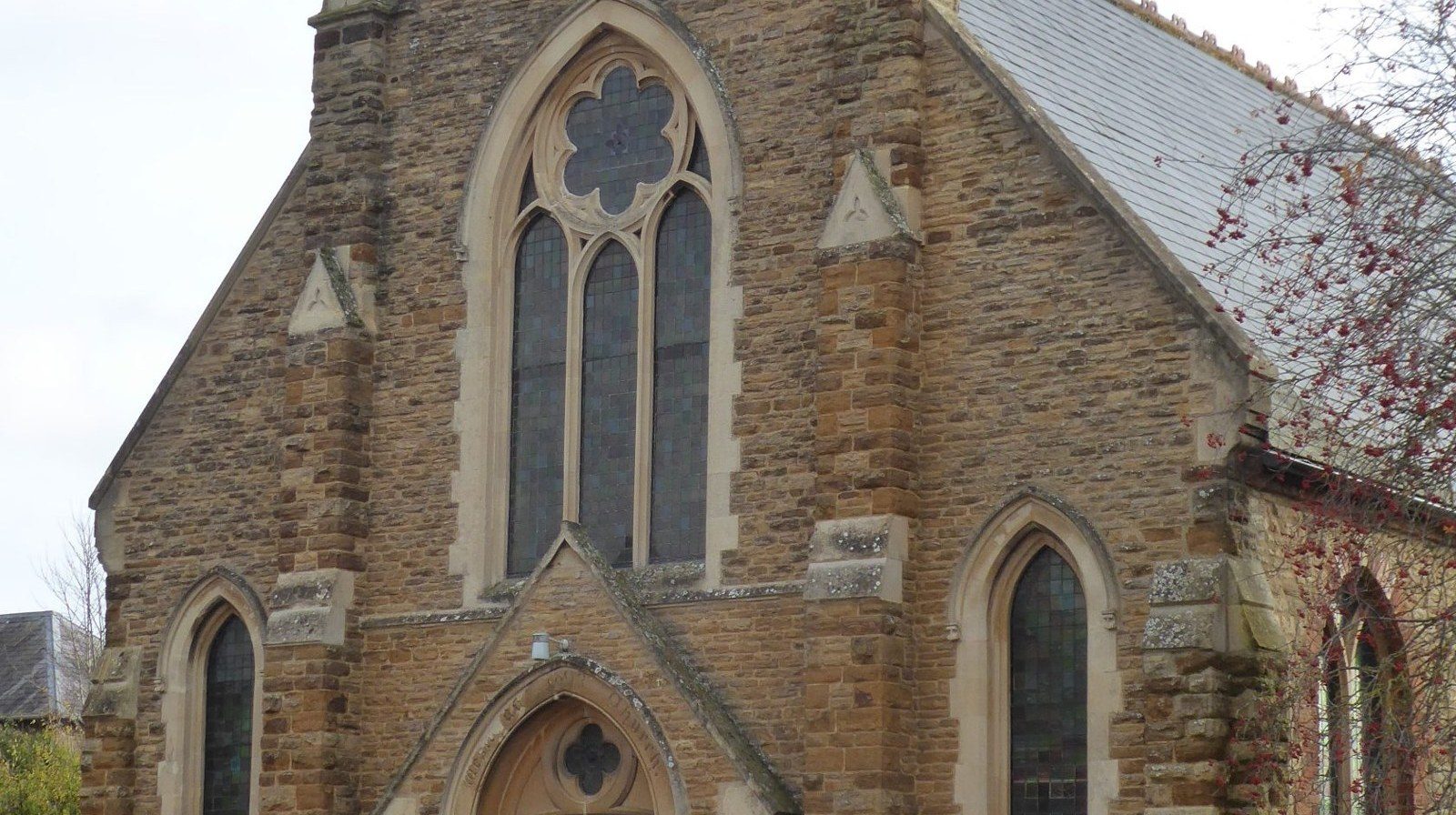
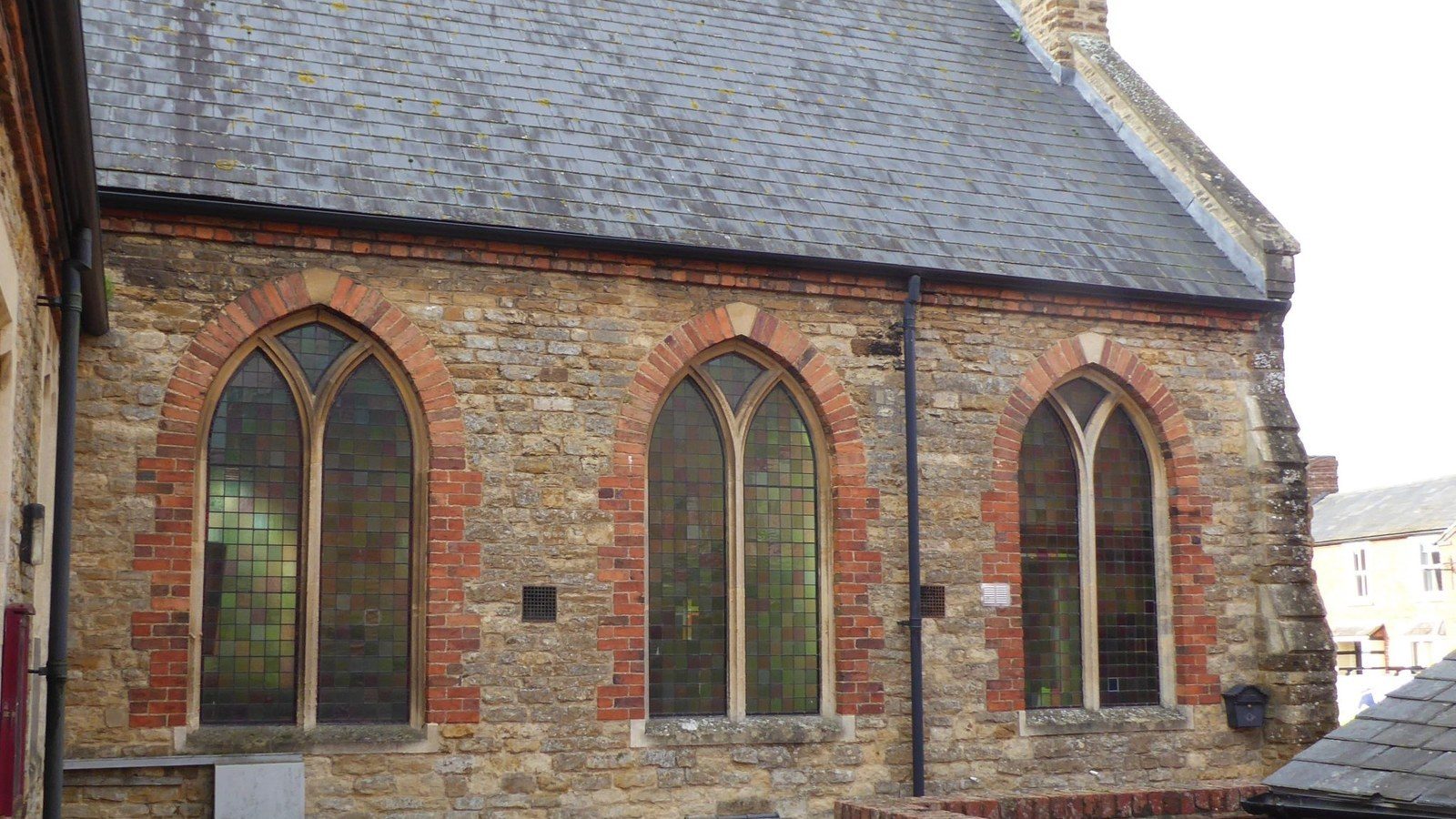
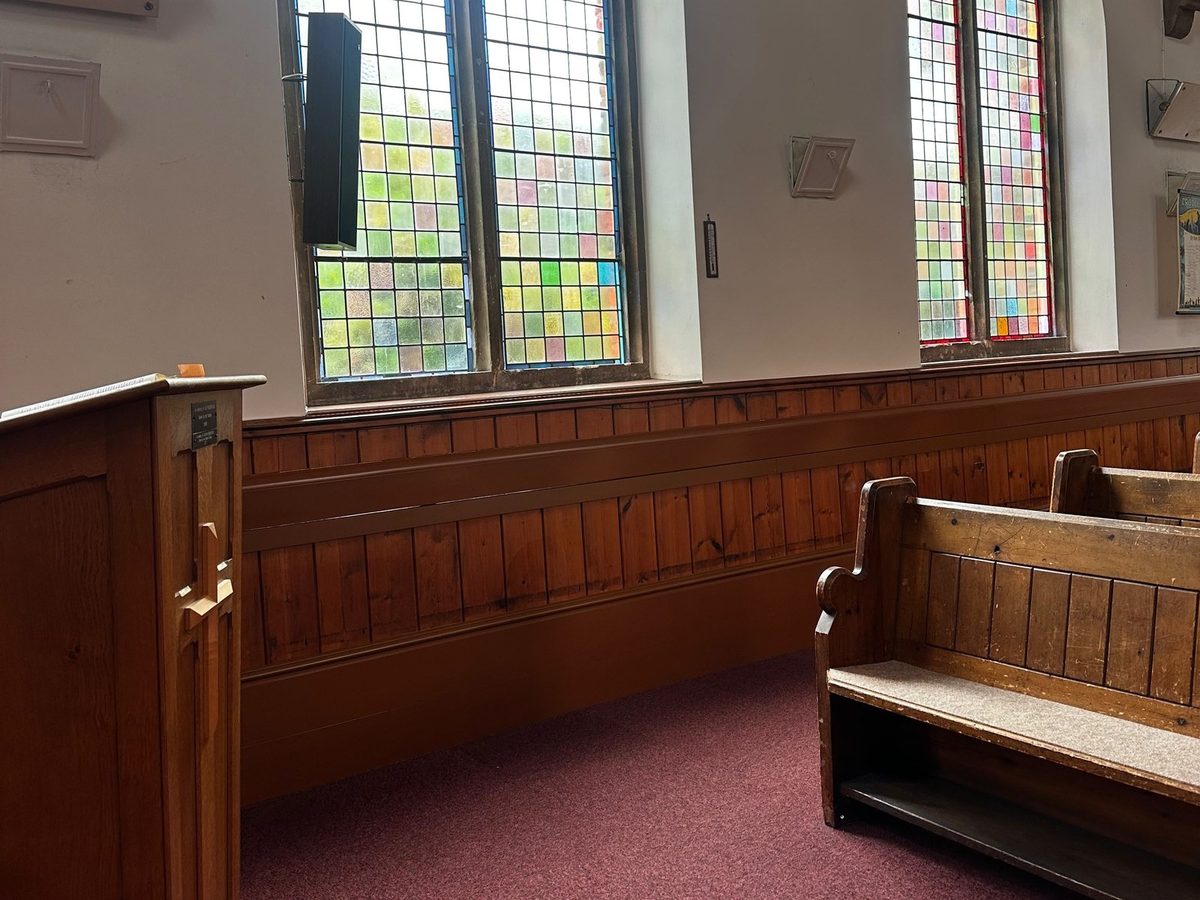
Towcester Methodist Church on Brackley Road is a Victorian ironstone chapel, its foundation stone laid in June 1893. The nave is a tall, open volume beneath an exposed timber roof, lit by large leaded and stained glass windows, with traditional pine panelling running around the walls to sill height. Like most churches of its age, the fabric was never designed with thermal performance in mind.
The building is also used intermittently: services and gatherings for a few hours at a time, with long unoccupied periods in between. That combination is the defining heating problem for churches. A high heat demand has to be met in a large, poorly insulated space, and it has to be met on demand rather than around the clock. The brief set by the church was to:
- Meet the heat demand of the nave to a design target of 18°C in a large, poorly insulated space.
- Respond to intermittent use, bringing the space to comfort for services without heating an empty building all week.
- Respect the character of the interior, keeping new services out of sight of the panelling, stained glass and roof structure.
- Avoid disruptive works, with no new pipework, plant or disturbance to floors and ceilings.
- Allow remote management by the church's maintenance team, who are not on site day to day.
“Like a lot of churches, we have a big, tall building that is only used for a few hours at a time. Heating it properly without spoiling it was always going to be the hard part.”
Why Traditional Emitters Fell Short
Electric radiators and wall-mounted panel heaters were considered and ruled out by the church on efficiency and aesthetic grounds. Panel heaters work mainly by warming air, and in a nave of this height that warm air rises into the roof space, away from the congregation. Fixing a row of white boxes to the painted walls and panelling would also have been visually intrusive in an interior defined by its joinery and glass.
Overhead radiant panels are the other common answer in churches. They deliver radiant heat, but they introduce visible equipment at high level, compete with the exposed roof trusses and windows, and require wiring routes across walls and ceilings that are difficult to conceal in a building of this character.
The Solution
ThermaSkirt-e, DiscreteHeat's direct electric skirting heating range, was specified. Each profile carries a self-regulating heating element that emits far-infrared radiant heat from low level, warming people, pews and the building fabric directly rather than relying principally on heated air. As a direct electric system there is no boiler, no water volume and no screed to bring up to temperature, which suits a building heated for short, scheduled periods.
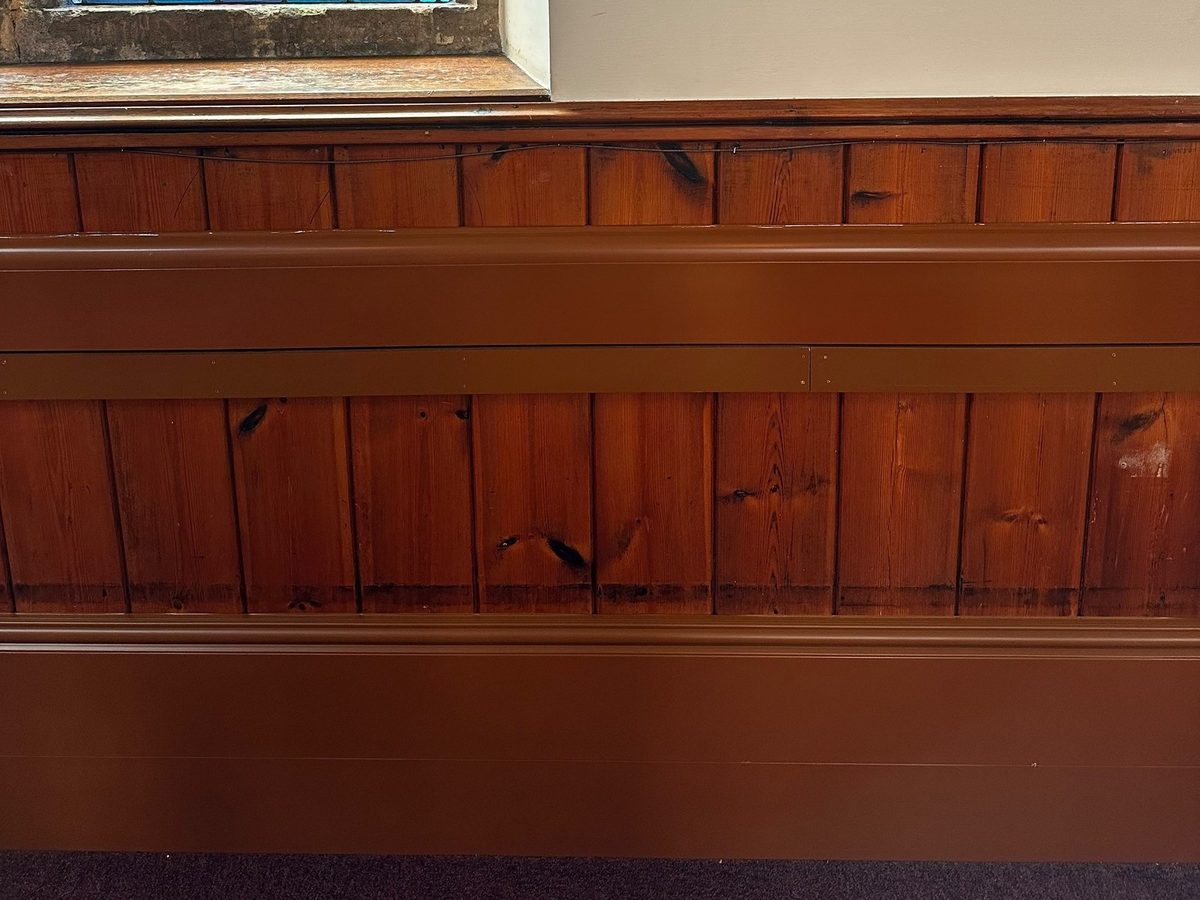
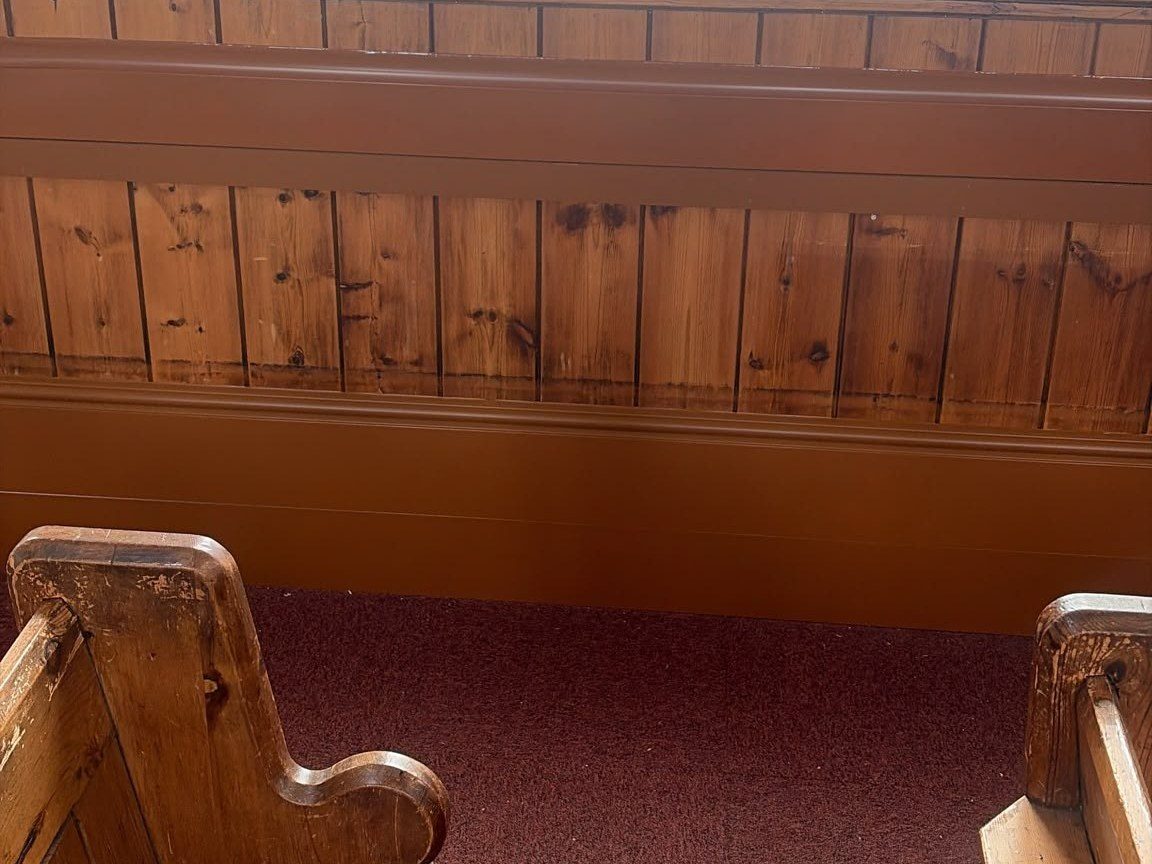
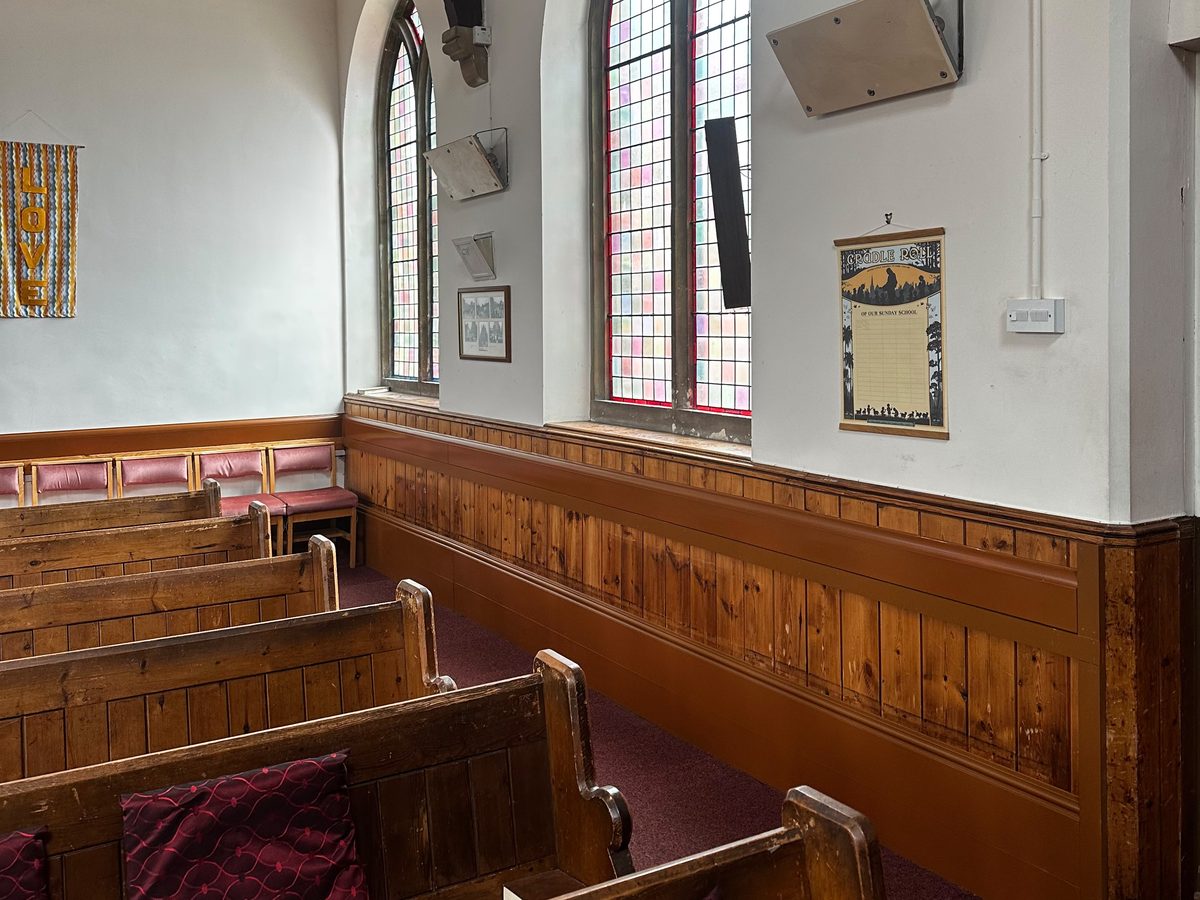
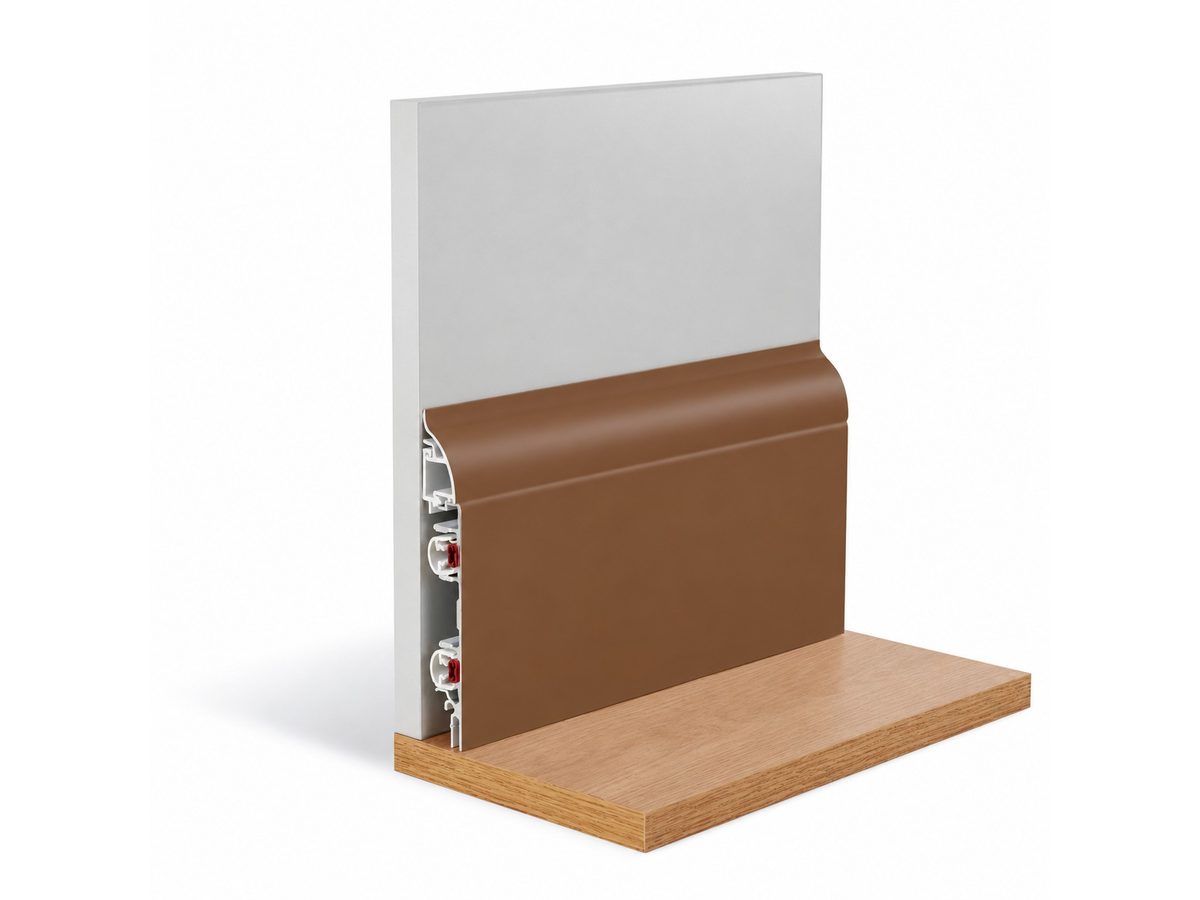
To meet the nave's heat demand within the available wall length, the design uses two tiers. At skirting level, Deco BMe3 high output profiles are installed as a double bank, two profiles high, finished with a traditional torus capping. Above them, a single bank of Deco BMe2 runs at mid-panel height with an ovolo capping. Every profile was finished in a custom colour matched to the existing pine panelling, so the system reads as part of the original joinery.
Key advantages for the church brief:
- Heat where the congregation sits. Low-level radiant heat warms occupants and surfaces in the occupied zone, rather than filling a tall volume with warm air that collects under the roof.
- Suited to intermittent use. Direct electric operation with no wet system or slab to heat, scheduled around services and lettings through programmable controls.
- Architectural sympathy. Colour matched profiles with torus and ovolo cappings follow the line of the existing panelling. Nothing is mounted on the plaster, at high level or across the stained glass.
- No intrusive works. No pipework, no plant room and no disturbance to floors or ceilings. The system fixes at wall level and is fed from new dedicated electrical supplies.
- Inherent safety. The self-regulating element will not exceed its maximum temperature, even when covered, and there are no transformers or wiring centres.
- Floor space untouched. Pews, aisles and circulation are unaffected, with nothing projecting into the nave.
The Specification
Profile Selection
Deco BMe3 (170mm high output profile) was installed as a double bank at skirting level along 24.4m of heated perimeter, totalling 48.8m and providing 8,784W, approximately 180W per metre. Deco BMe2 (114mm) was installed as a single bank at mid-panel height along the same 24.4m, providing 3,050W, approximately 125W per metre. Combined, 73.2m of ThermaSkirt-e delivers a designed output of 11,834W to an internal design target of 18°C. Stacking the high output profile at skirting level and adding a mid-panel tier achieved the required output within the panelled wall length, without extending onto the painted plaster.
Electrical Supply & Circuit Protection
This is an entirely new installation on dedicated supplies. Total steady-state running current is 51.45A (38.19A for the BMe3 runs and 13.26A for the BMe2 run). At low ambient temperatures inrush current may reach 1.2 times the steady-state figure, so each circuit is protected by a Type C or D 30mA RCBO of sufficient capacity to avoid nuisance tripping. ThermaSkirt-e connects directly to the supply with no transformers or wiring centres, and is installed by a competent electrician to BS 7671.
Run Configuration
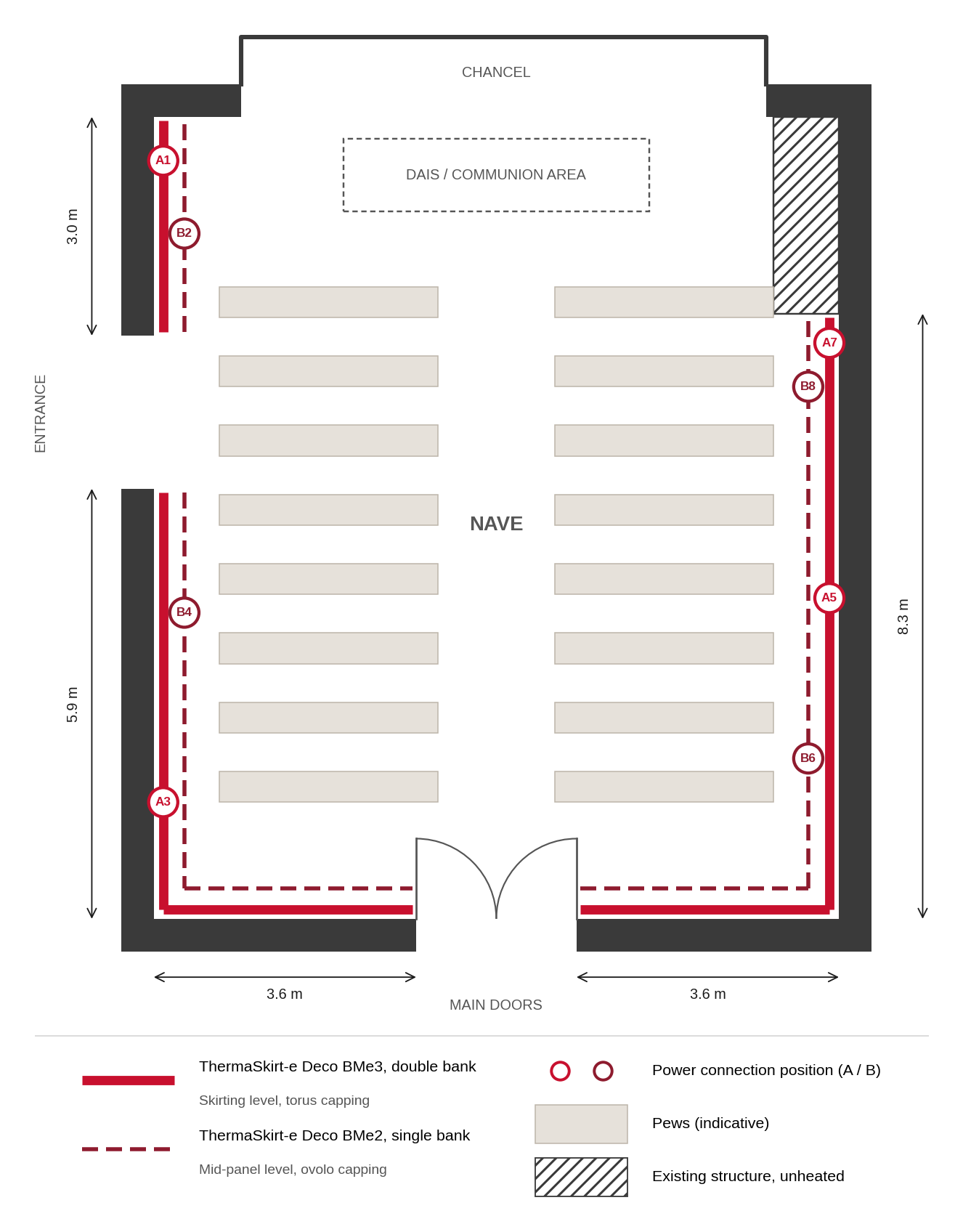
Each ThermaSkirt-e run requires its own power connection, with maximum run lengths of 15m for BMe3 and 20m for BMe2 on a 13A fused supply. Runs are distributed along both side walls and the main door wall of the nave, with connections at eight positions: four serving the skirting-level double bank (one feed per bank) and four serving the mid-panel run. Connection points were positioned to sit behind the profiles and avoid existing sockets.
Controls Strategy
The system is controlled by Salus Quantum digital programmable thermostats with Wi-Fi connectivity. Heating can be scheduled around services and lettings, and the church's maintenance team have remote access to adjust settings and monitor the system without needing to be on site.
Finish & Heritage Integration
The RAL finish was selected by the church, which intends to carry it through its redecoration programme to unify finishes across the interior. Torus capping at skirting level and ovolo capping at mid-panel height echo traditional joinery mouldings. Profiles are made to order: cut, prepped, finished and packaged to the project schedule.
Compliance & Credentials
- CE Marked to the Low Voltage Directive
- Tested to EN 60335-2-30, with EMC test certification
- Self-regulating element: will not exceed maximum temperature when covered
- Installed by IHS, a Registered ThermaSkirt Installer, supported by the DiscreteHeat Special Projects team
- 5-year manufacturer warranty on the heating element
Heating Layout
The heated perimeter follows both side walls of the nave and the wall either side of the main doors. The chancel and the structure at the head of one side wall remain unheated. The plan below shows the two tiers offset for clarity; on elevation the mid-panel BMe2 run sits directly above the skirting-level BMe3 double bank.
| Profile | Length | Output | Current |
|---|---|---|---|
| Deco BMe3 (2 banks) | 48.8m | 8,784W | 38.19A |
| Deco BMe2 (1 bank) | 24.4m | 3,050W | 13.26A |
| Total | 73.2m | 11,834W | 51.45A |
The Outcome
The completed installation delivers a whole-nave heating system that answers each element of the brief without altering the character of the interior.
- Designed output in place. 73.2m of ThermaSkirt-e providing 11,834W around the nave perimeter, sized to an 18°C design target.
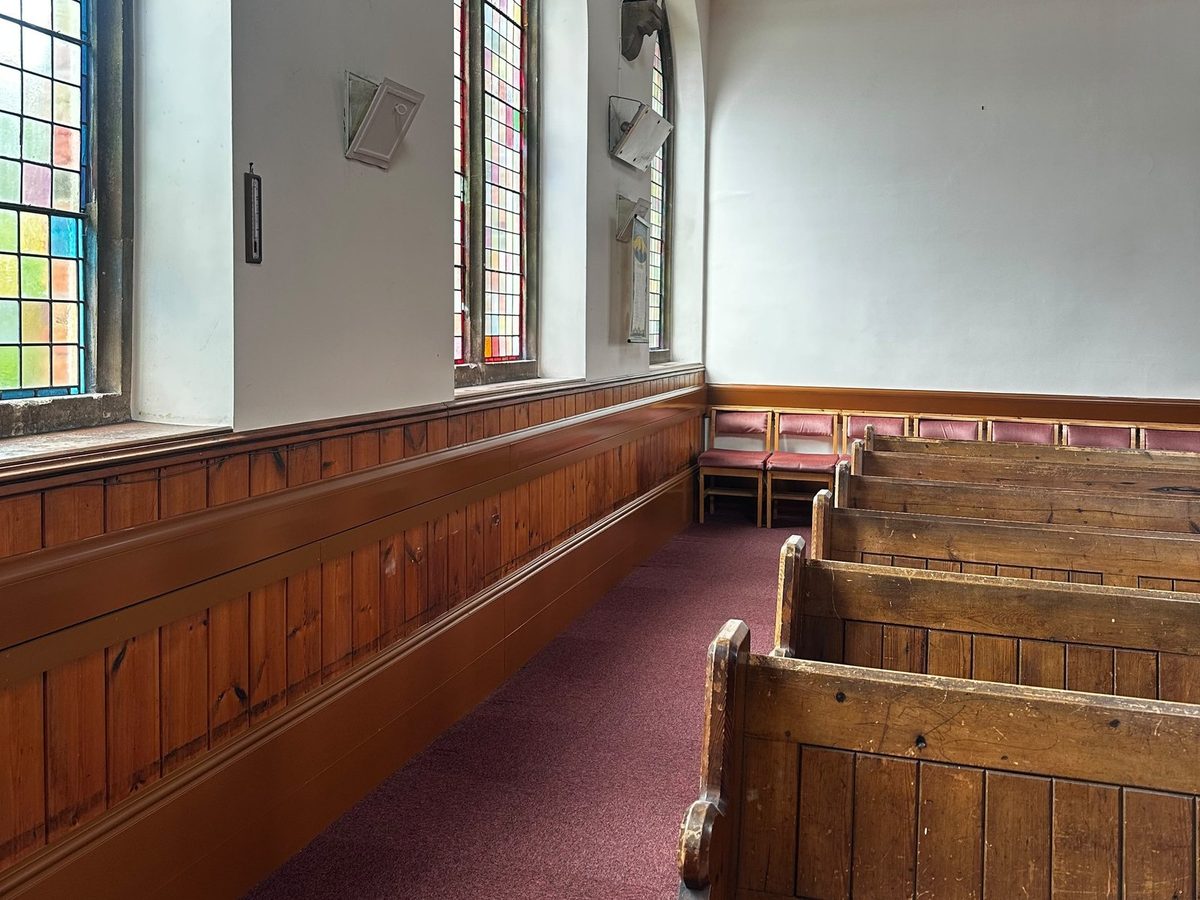
- Visually integrated. Colour matched profiles and traditional cappings sit within the line of the pine panelling, with no visible heaters on the walls or at high level.
- Managed remotely. Wi-Fi thermostats let the church schedule heat around services and monitor the system from off site.
- Minimal disruption. No pipework, plant or floor and ceiling works, with the interior and seating left intact.
- Proven approach. Towcester is one of more than 20 churches completed with this type of ThermaSkirt-e system.
“Most people haven't noticed it's there until they feel the warmth. It looks as though it has always been part of the panelling.”
Voices from the Project
“We wanted heating that would warm the people in the pews when we need it, that we could manage without being on site, and that respected the building. ThermaSkirt has given us all three.”
“Churches ask two things of a heating system: deliver heat to people when the building is in use, and do it without compromising the interior. Towcester shows ThermaSkirt-e doing both, and it joins more than 20 church projects completed on the same principle.”
Conclusion
Towcester Methodist Church demonstrates that a tall, poorly insulated nave with intermittent occupancy can be heated with a low-level radiant system that leaves no visible mark on a historic interior. By stacking high output profiles at skirting level and adding a mid-panel tier, the design met the heat demand within the existing panelled wall length, while colour matching and traditional cappings made the system part of the joinery. For specifiers and church councils weighing panel heaters or overhead radiant systems against architectural sensitivity, it is a working precedent for a third option.
Heating a church or heritage building?
Download the Specifier Pack for ThermaSkirt-e datasheets covering Deco BMe2 and BMe3, installation instructions and independent test data.