What's the Hurry?
For as long as anyone can remember The UK has relied on fossil fuels like natural gas, oil and coal to power our homes, industry and transport.
Although these fuels have enabled the UK to develop both economically and technologically, time is running out due to the impact of climate change and the resultant changes in the worlds' weather. North sea oil is depleting, the opportunity for shale fracking seems to have passed and other sources such as Russia and the Middle East make uneasy bed-fellows.
The Climate Change Act was passed by the UK government in 2008 as a 1st step in tackling the issue. The Act ensures that the UK's carbon emissions are at least 80% lower than the 1990 baseline by 2050. The Act also gives the Secretary of State for Energy and Climate Change powers to introduce new measures to achieve these targets.
It's not going to be easy, especially when you consider that there are a number of competing and apparently contradictory objectives set out by the Department of Business, Energy and Industrial Strategy (BEIS): Ensure a secure and robust energy supply; Reduce energy bills or keep them as low as possible; Encourage home improvements to reduce energy consumption; Reduce carbon emissions cost-effectively at home.
So there has to be big, long term changes to way we heat our homes, but with lower ongoing energy bills & minimal up-front costs.
The Story So Far
The establishment of the Committee on Climate Change (CCC) directly followed the Climate Change Act, which is an independent advisory body which informs the government as to progess in reaching required carbon levels. This progress is reported to Parliament.
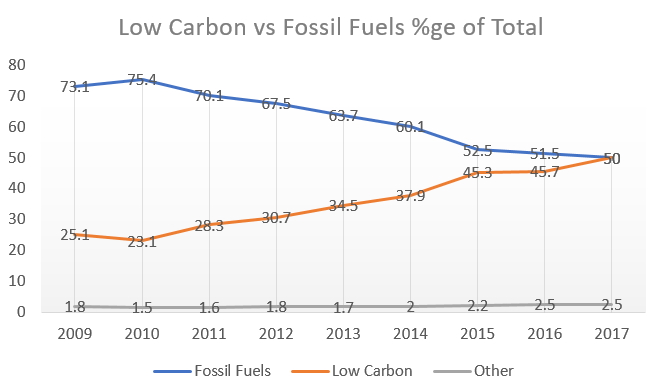
2017 was the first year that more electricity was generated from renewable sources than fossil fuels As a result 2017, UK emissions were more than 40% lower than 1990 levels with most of the reduction in carbon down to impressive progress in reducing emissions from electricity generation. The UK is currently forecasted to outperform the second (2013-17) and third (2018-22) carbon budgets. Currently the UK is unlikely to meet the fourth carbon budget which covers the period 2023-27. This is because the UK is falling behind in its progress in reducing the carbon created in heating our homes.
According to the committee on climate change (CCC):
“Meeting future carbon budgets and the UK's 2050 target to reduce emissions by at least 80% of 1990 levels will require reducing domestic emissions by at least 3% per year. This will require existing progress to be supplemented by more challenging measures.”
In 2018 Legislation was passed to phase out inefficient gas boilers; this regulation known as 'Boiler +' requires that all new Combi boilers must have a minimum energy efficiency of 92%. In March 2019 it was stated that from 2025 it will be illegal to install gas boilers in new build homes & the UK government plans to almost completely phase out the gas network to power homes by 2050.
Hydrogen: The Future of the Gas Network?
The report suggests that the most likely solution could very well be a hydrogen. Hydrogen only creates heat energy and water vapour when burned and so has zero CO2 emissions. Hydrogen is also very energy intensive as 1kg of hydrogen has the same amount of energy as 2.8kg of fuel oil.
It has been suggested that simply converting the Natural gas network to Hydrogen would be much more complicated than the switch from Town Gas in the 60's; Hydrogen molecules are much smaller than methane and so leaks and losses would be higher. Similarly, it is unclear whether the existing gas boiler stock could be cost effectively converted, as it is not a simple conversion to run an existing boiler on hydrogen as it was to swap the burner jets in the conversion from town to natural gas.
The CCC report indicates that the better option would be to combine different renewable technologies such as heat pumps, solar, biofuels etc to provide an overall low-carbon heat network.
The Chief executive of the CCC, Chris Stark, said:
“I've been cautious about the hydrogen story, because it's often portrayed as a panacea. [However] I've been surprised how well it's come out of our modelling when it's accompanied by energy efficiency and electrification from heat pumps.”
Heat Pumps
Heat pumps have long been touted as the future of home heating as they rely on the thermodynamic principle of the latent heat of evaporation to steal heat from the air (in the case of an air source heat pump) or earth (if a ground source heat pump). The concept has long been compared to a 'fridge in reverse'.
By running on direct electricity, the holy grail of heat pump performance measure has been a COP (Co-efficient of Performance) of 4:1 in which 1 kw of electrical energy creates 4kw of heat energy. Some Air Source heat pump manufacturers are achieving a seasonally adjusted COP approaching 3.9:1.
There are however some hurdles to overcome if heat pumps are to realistically become the go-to technology for home heating: They are more expensive to install and maintain; The installer network is far smaller than that for gas boilers; The emitters required are often larger and more complex to install than a standard panel radiator to compensate for the naturally lower water temperatures created by a heat pump.
Heat Pumps are growing in popularity, but still seem best applied in new build, off-gas projects where insulation levels are naturally very good and the oversized emitters required to allow them to perform properly can be installed from the get-go.
Direct Electric
Coming up on the rails is direct electric heating in the form of panel heaters or radiant skirting board heating. Until recently, direct electric heating was considered an anathema to low carbon construction and the drive to nett zero. However, the surge in renewable energy created from wind and solar has turned these assumptions on its head.
In the latest SAP 10 regulations, electricity has almost the same carbon footprint as natural gas. Electricity 0.234 kg/KwH, Gas: 0.203 kg/KwH — a difference of only 10% in terms of a 'penalty'.
What this means is that developers and housebuilders, who have to demonstrate compliance with SAP 10, are re-appraising the use of direct electric heating; none more so in apartments and multi-residential developments. The ease of installation and the lack of pipework, distribution manifolds, heat interface units and even combined heat and power plants (CHP) means a huge capital saving.
So that's it then — no more gas boilers?
Well, no to be honest. The Government has a poor track record on these things. It's clear that 'something must be done' and that decarbonising our economy and in particular our home heating is a 'good thing'. However without some serious joined up thinking, the transition will be challenging.
If the Government is serious about phasing out Gas boilers by 2030 or even 2035 then it really needs to get it's ducks in a row. A clear and coherent strategy will require flexibility as well as clarity; a reliance on one measure is likely to prove unworkable.
There is no one size fits all. The reality is that a mixture of technologies; hydrogen, heat pumps, solar, bio mass and yes, Boilers will be the only, and sensible way of achieving Nett Zero by 2050.
So not so much B*ollocks to Boilers, or even Bye Bye boilers, more like au revoir, auf wiedersehen, arrivederci!